
Grace Murray Hopper
|
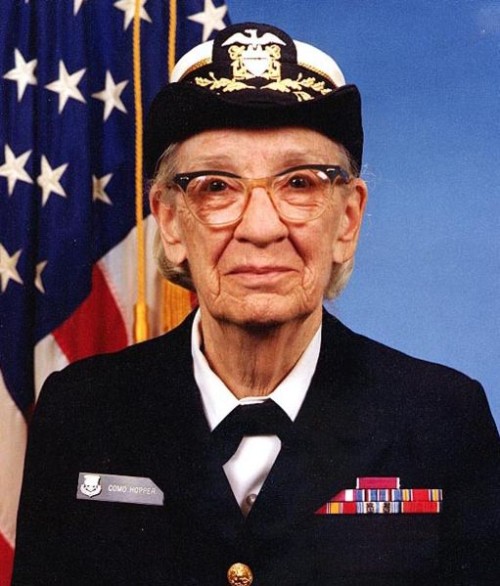
Grace Murray Hopper Rear Admiral Grace Murray Hopper (December 9, 1906 – January 1, 1992) was an American computer scientist and United States Navy officer. A pioneer in the field, she was one of the first programmers of the Harvard Mark I calculator, and she developed the first compiler for a computer programming language. Because of the breadth of her accomplishments and her naval rank, she is sometimes referred to as "Amazing Grace". When Grace Brewster Murray gained her PhD in Mathematics from Yale University, she was one of only four female students in the doctoral programme. She went on to work as associate professor at Vassar Collage until the outbreak of World War II. In 1943, she joined the US Naval Reserve as a lieutenant and worked for the Bureau of Ordnance Computation at Harvard where she learned how to programme the Mark I computer.
She used the Mark I to compute firing tables for weapons. She obtained mathematical formulas for firing tables, then wrote them as a series of instructions for the computer to follow. Those instructions were then translated into binary code (a system which uses only two digits, 0 and 1) that the computer can understand. These were delivered as punched holes in reels of paper. Punched holes were 1's and were read as switch ON, allowing the current to flow through. Zeroes were covered and were read as switch OFF and the current would not flow. Although this was laborious work, once the computer was programmed, it could perform the same computations quickly and many times over, saving time in the long run. In 1946 Grace Hopper published a book A Manual of Operations for the Automatic Sequence Controlled Calculator.
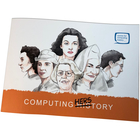
Grace continued her work with the Harvard Mark II and Mark III. She wanted to write computer programs that would allow other scientists and eventually non-scientists to use computers directly, instead of having to depend on computer specialists to do this for them. Her colleagues told her it wouldn't happen, because only scientists had the necessary knowledge to use computers. Hopper was determined to make computers accessible to many other people in the future. In 1949 she left Harvard and started working at Eckert-Mauchley Computer Corporation in Philadelphia, Pennsylvania. She joined the team working on construction of the Universal Automatic Computer, Univac I. It used vacuum tubes instead of electromechanical relay switches and was to be twenty times faster than the Mark III. It also had internal memory. Her original staff comprised four men and four women. Hopper liked hiring women. She said, "Women turn out to be very good programmers for one very good reason. They tend to finish up things, and men don't very often finish." Her next goal was to get the computer to translate its own codes and call on preprogrammed subroutines when needed. She finished the program in 1952 and called it the A-0 compiler. That same year the Navy promoted her to lieutenant commander. She then started working on a program that would be used for business-oriented tasks. By 1955 she finished the code with twenty business commands, such as "count" and "display". Her program, named FLOW-MATIC, became a model for a new program COBOL (COmmon Business Oriented Language), which was developed by a team of programmers overseen by Grace Hopper. She was later referred to as Grandmother of COBOL. In 1966 Hopper was promoted by the Navy to commander, but she had reached the legal limit of twenty years for serving as a reservist and on December 31, 1966, she retired. Within six months the Navy officials decided they needed her back to work with COBOL, so they asked her to come back on temporary duty, which was later changed to "indefinite". Her new job was to combine various versions of COBOL into USA Standard COBOL. Her office had a skull-and-crossbones flag and a wall clock that ran backwards. This was to remind people to be flexible in their thinking. Rear Admiral Hopper became Fellow of the Institute of Electrical and Electronics Engineers and in 1979 she won IEEE's McDowell Award. In 1985, Grace Hopper was appointed Rear Admiral by President Ronald Reagan, making her one of only a very few female admirals in the US Navy. In 1986, she retired again, this time for good. She was the nation's oldest military officer on active duty. After her retirement from the Navy she accepted a position with Digital Equipment Corporation as senior consultant, where she remained until her death. In 1991 President George Bush awarded her the National Medal of Technology. She was the first individual to receive it. Rear Admiral Hopper was one of the women profiled in our Women in Computing Festival 2017 of entitled Where Did All the Women Go?. Click here for the Women in Computing timeline created for that event. Historical Timeline for Grace Murray Hopper :
|
 Click for a larger version
 |