Computer Museum
Follow Us On Twitter Join Our Group On Facebook Join Our Group On Facebook

Pure Energy - Web Design & Hosting
  

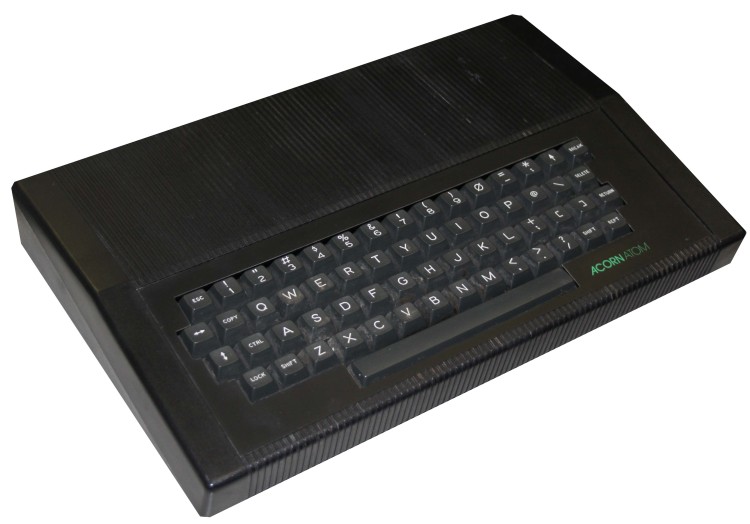
Acorn Atom

The Acorn Atom was a home computer made by Acorn Computers Ltd from 1980 to 1981 it was the forerunner to the hugely popular BBC Computer System, it was then replaced by the BBC Micro (originally Proton) and later the Acorn Electron.

The Atom was a progression of the MOS Technology 6502 based machines that the company had been making from 1979. The Atom was a cut-down Acorn System 3 without a disk drive but had an integral keyboard and cassette tape interface, sold in either kit or complete form. In 1980 it was priced between £120 in kit form, £170 ready assembled, to over £200 for the fully expanded version with 12 KB of RAM and the floating point extension ROM.

The basic Atom had 2 KB of RAM and 8 KB of ROM, with a fully loaded machine having 12 KB of each. An additional floating point ROM was also available. The 12 KB of RAM was divided between 5 KB available for programs, 1 KB for the page zero and 6 KB for the high resolution graphics. The page zero memory (a.k.a. zero page memory) was used by the CPU for stack storage, by the OS, and by the Atom BASIC for variable storage of the 27 variables. If high resolution graphics were not required then 5 1/2 KB of the upper memory could be used for program storage.

The video chip, allowed for text or two-colour graphics modes. It could be connected to a TV or modified to connect and output to a video monitor.The Basic video memory was 1 KB but could be expanded to 6 KB. Six video modes were available, with resolutions from 64×64 in 4 colours, up to 256×192 in monochrome. At the time 256×192 was considered to be high resolution.

It came built-in with Atom BASIC, a fast but idiosyncratic version, which included indirection operators for bytes and words (4 bytes). Assembly code could be included within a BASIC program, because the BASIC interpreter also contained an Assembler for the 6502 assembly language which assembled the inline code during program execution and then executed it. This was a very unusual, but also very useful, function.

In late 1982, Acorn released an upgrade ROM chip for the Atom which allowed users to switch between Atom BASIC and the more advanced BASIC used by the BBC Micro. The upgrade was purely to the programming language; the Atom's graphics and sound capabilities remained unchanged, and hence, contrary to some pre-release beliefs, the BBC BASIC ROM did not allow Atom users to run commercial BBC Micro software, since nearly all of it took advantage of the BBC machine's advanced graphics and sound hardware.

The case was designed by industrial designer Allen Boothroyd of Cambridge Product Design Ltd.

Manufacturer: Acorn
Date: January 1980

Acorn Atom Manuals :

Item Manufacturer Date
Acorn Atom Circuit Diagram Acorn 28-02-1980

Acorn Atom Software :

Item Manufacturer Date
Acornsoft Games Pack 1 Acornsoft
Acornsoft Games Pack 9 Acornsoft
Acornsoft Games Pack 8 Acornsoft 1983

Acorn Atom Games :

Item Manufacturer Date
Space Fighter Program Power
Atom Invaders Bug-Byte
Astro Battlezone Control Technology 1982
Omega Mission Micromania 1982
Defender Micromania 1982

Acorn Atom Promotional Items / Literature:

Item Manufacturer Date
Acornsoft - BBC Microcomputer and Electron Games Acornsoft November 1984

Books RELATED to Acorn Atom in our Library

Item Manufacturer Date
Getting acquainted with your Acorn Atom Interface 1981

Magazines RELATED to Acorn Atom in our Library

Item Manufacturer Date
Personal Computer World - July 1980 July 1980
Computer Age - September 1980 Computer Age September 1980
Computer Age - February 1981 Computer Age February 1981
Personal Computer World - March 1981 March 1981
Personal Computer World - November 1981 November 1981
Your Computer - November 1981 November 1981
Practical Computing - January 1982 January 1982
Practical Computing - October 1982 October 1982
Personal Computer World - November 1982 November 1982
Acorn User - August 1985 August 1985
Acorn User - September 1985 September 1985
Acorn User - October 1985 October 1985
Practical Computing - November 1980 25-08-2009

Other Systems Related To Acorn Atom:

Item Manufacturer Date
Acorn Xemplar Matrix NC Acorn Unknown
Acorn A3010 Acorn Unknown
Acorn STB-1 Acorn Unknown
Acorn BBC Micro Model B Acorn 1981
Acorn BBC Micro Model A Acorn 1981
Acorn BBC Micro Model A Issue 1 Acorn 1981
Acorn BBC Micro Model B+ (64K) Acorn February 1981
Acorn Electron Acorn July 1983
Acorn Briefcase Communicator Acorn 1985
Acorn BBC Master 128 Acorn 1986
Acorn BBC Domesday System Acorn Computers Limited 1986
Acorn - BT Merlin M2105 Acorn 13rd May 1986
Acorn BBC Master Compact Acorn September 1986
Acorn Archimedes 310 Acorn 1987
Acorn Archimedes 305 Acorn 1987
Acorn Archimedes 440 Acorn July 1987
Acorn A3000 Acorn 1989
Acorn R140 Acorn June 1989
Acorn Archimedes 440/1 Acorn July 1989
Acorn R260 Acorn 1990
Acorn A5000 Acorn 1991
Acorn A5000 ALB53 Acorn 1991
Acorn A5000 ALB22 Acorn 1991
Acorn A3020 Acorn January 1992
Acorn A4000 Acorn September 1992
Acorn Risc PC 600 Acorn January 1994
Acorn Risc PC 600 ACB25 Acorn April 1994
Acorn Risc PC 600 ACB45 Acorn April 1994
Acorn A7000 Acorn 1995
Acorn RISC PC 700 - Prototype Acorn 1995
Acorn Pocket Book II Acorn February 1995
Acorn Risc PC 600 ACB60 Acorn July 1995
Acorn StrongARM RiscPC Acorn 1996

This exhibit has a reference ID of CH530. Please quote this reference ID in any communication with the Centre for Computing History.


Acorn Atom

Click on the Image(s) For Detail


User Submitted Articles

Article
The Social Impact of Computers - One Man's Story


Add Your Article >>>

© The Centre for Computing History - Computer Museum Registered Charity Number 1130071  Web Design : Pure Energy    Powered By SiteWise