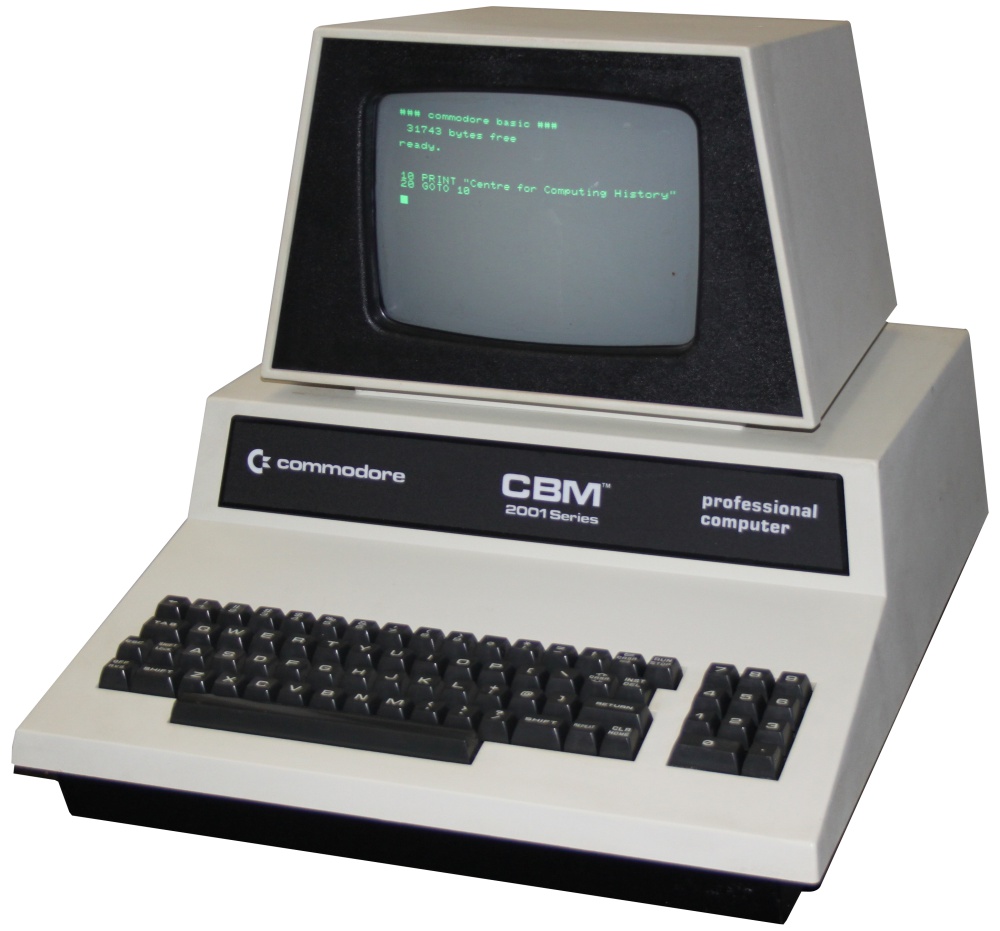

Commodore PET 2001-32N
| Home > Browse Our Collection > Computers > Commodore > Commodore PET 2001-32N |
|
I have inherited the PET from my late fathers estate. My father, the economic consultant Michael Lee, purchased the PET in, I think, 1979 in London for use in his business, in particular processing shopping surveys. He shortly afterwards bought a 5.25” dual floppy disk drive and tractor printer to use with the PET, and I believe this was quite ahead of its time. I remember my father saying that the shop he bought the machine from used to send prospective clients round to his office in Jermyn Street in London to see the full system in use! I learned BASIC using the PET in 1980 using a self-teaching course from Strathclyde University. My father and I enjoyed entering and editing games programs from Creative Computing magazine, and similar books on Saturday afternoons in his office. In business use the PET enabled my father to process in a couple of days what had before taken a couple of weeks. The PET was eventually replaced in my fathers office by a Sirius Apricot machine (also available to donate should it be of interest), then by a succession of PCs. It spent 30 years in my parents attic from where I inherited it last year. The PET is in working order, and the disk drive and printer are at least electrically active (the power lights come on) but I’ve not been able to test them further as yet. All the units have their original dust covers (slightly dusty) I have also inherited a box of documentation, including the 1979 user manual for the PET, the Strathclyde BASIC course book, plus a variety of disks, computing books and software, which I would be happy to include in the donation as a collection. I note and am happy to offer this donation under the terms of your Collections Development Policy. Should you be interested in receiving this donation I will be happy to inventorise it as per your form – though the key items are listed below. I worked briefly for the Museums Documentation Association in Cambridge, so appreciate the value of good records! I am keen for this PET to go to a ‘good home’ and I’m particularly interested that you use your collection in education. I learned on this machine, and would be greatly satisfied to think that it could contribute to education in future. Though I live in Wiltshire now I would be happy to bring the donated items to you in Cambridge. As a further connection to Cambridge, my nephew studied computing at Cambridge University, and now runs a computing education company in London.
The PET was one of the biggest sellers in the 1979 / 1980 period, when computers were aimed at both the home and business market. This was a revised model of the first machine, with new keyboard launched in 1977 and was used for education, hobbyists, and some business users. The first machines had either 4K or 8K of RAM, but this was very limiting so several third-party memory expansion boards were available to take the memory up to 32K. It has a built in system ROM (6K) and BASIC (8K), and with additional memory could run 6502 assemblers and even compilers. The screen could display upper and lower case letters, and a large range of graphics symbols, a large library of software was produced for the machine. The 2001 model was found to be slow in updating its display, until someone discovered a way of speeding up the graphics routines with a POKE to memory. This was fine, but on later machines the graphics hardware was improved and the same POKE caused the screen to go blank and was known as 'the killer POKE'. This version now included 32K of RAM, hence the name, and also had an updated Kernel ROM to support Commodore's new range of disk drives. Manufacturer: Commodore Comment on This Page Commodore PET 2001-32N Manuals:
Commodore PET 2001-32N Articles:
Magazines RELATED to Commodore PET 2001-32N in our Library
Other Systems Related To Commodore PET 2001-32N:This exhibit has a reference ID of CH55611. Please quote this reference ID in any communication with the Centre for Computing History. |
Click on the Image(s) For Detail
|