
Sinclair ZX Spectrum 48K (BBC)
| Home > Browse Our Collection > Computers > Sinclair > Sinclair ZX Spectrum 48K (BBC) |
|
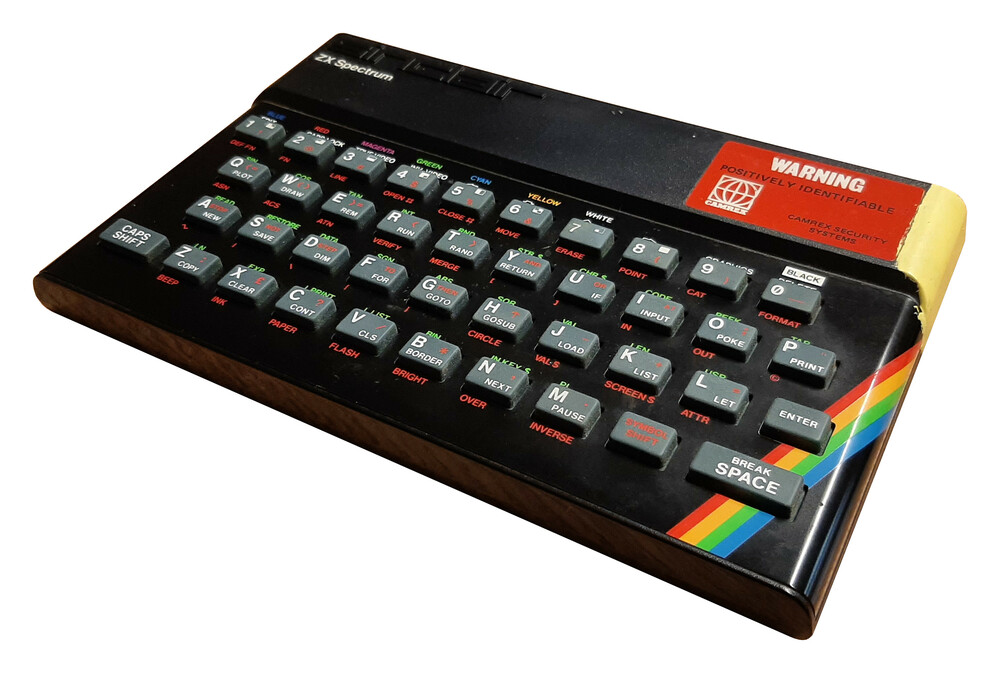
This Spectrum was held at the BBC White City, and was kindly donated by Andy Finney
It has the serial number 036-235046
The ZX Spectrum is remembered for its rubber keyboard, small compact size and distinctive rainbow motif. It was originally released in 1982 with 16 KB of RAM for £125 Sterling or with 48 KB for £175, these prices were later reduced to £99 and £129 respectively.Owners of the 16 KB model could purchase an internal 32 KB RAM upgrade.
Later issue machines required the fitting of 8 dynamic RAM chips and a few TTL chips. Users were able mail their 16K Spectrums to Sinclair to be upgraded to 48 KB versions. To reduce the price, the 32 KB extension used eight faulty 64 kilobit chips with only one half of their capacity working and/or available. External 32 KB RAM packs that mounted in the rear expansion slot were also available from third parties. Both machines had 16 KB of onboard ROM.
Approximately 60,000 "Issue 1" ZX Spectrums were manufactured; they can be distinguished from later models by the colour of the keys (light grey for Issue 1, blue-grey for later models).
The Spectrum built on the success of the predecessor ZX81 machine, launching in April 1982, and within a year, it had sold close to a million units, despite early production problems and lengthy waiting lists.
The machine was to have had a faster and more expansive BASIC than what it eventually shipped with. A company local to Cambridge, Nine Tiles, who are still working in the industry today had produced the ZX80 and 81 BASIC, and they continued work after the launch of the Spectrum BASIC to add peripheral support, but after a few months it became clear that too many machines had been sold to make sending out replacment BASIC ROMS economical, so all work stopped, Nine Tiles were not to work with Sinclair again.
This meant that all future peripherals had to have a chip installed in the interface with the computer, and recognise anything plugged into the edge connector.
The machine was soon to be one of the countrie's leading games machines, with every major and minor games company producing software for it. It became the home of many classic games of the era, and making household names of companies such as Ultimate Play the Game, Ocean, Hewson and Durell to name but a few.
In 1984, the machine would receive a makeover in the form of the Spectrum+, which would have a new, sturdier case, better more solid keys. This could be bought as a new machine, or a customer could send their old machine back to Sinclair who would fit the new keyboard for them. This new case also connected a new feature for the Spectrum, which was a reset button, so the machine could go back to prompt, without having to pull out the power cord.
A polarising feature of most Sinclair computers were the single press keys, to achieve the word Load for instance meant pressing the J key, this led to the user having to learn the position of the words all over the keyboard, some loved the speed that could be achieved, others found it an unnecessary chore.
Unfortunately by this time the market was becoming very crowded with new machines and the Spectrum+ did not sell as well as expected. At the same time the company wanted a slice of the lucrative business market, and so produced the QL, which was a costly failure due to unreliability, slow performance, and competing with the likes of Amstrad who's machines were falling in price all the time, this, along with the C5 car would drain Sinclair of much needed funds.
This meant the last Sinclair Research produced computer the Spectrum 128K was more of an upgrade than a fully fledged successor. Money constraints meant that the case was the same as the Spectrum +, It contained a Basic GUI that had an option for a new 128K BASIC, that used a normal typing a word, a tape tester, calculator, and a 48K backwards compatible mode.
The best new feature though was the new AY chip, which was considerably better than the noise chip used before, and now the internal speaker was replaced by the sound coming from the TV.
The new chips came at a price though, the computer produced more heat, and so a large heatsink was attached to the side, giving the machine it's affectionate name of toastrack.
By 1986 Sinclair were in considerable money trouble, and Sinclair was to sell the computer brand (but not the company) to Amstrad, under the new manufacturer the machine gained an army of new fans, and gained a second wind, Alan Sugar's company would go on to produce Spectrum models up until 1992.
It is often lamented by both ex Sinclair engineers and fans of the computer that no 16 bit successor was ever produced.
The computer in it's various forms would sell between five and six million units, probably only surpassed by the C64 in the UK.
Manufacturer: Sinclair Comment on This Page Other Systems Related To Sinclair ZX Spectrum 48K (BBC):This exhibit has a reference ID of CH67607. Please quote this reference ID in any communication with the Centre for Computing History. |

|